Harrison EDEH
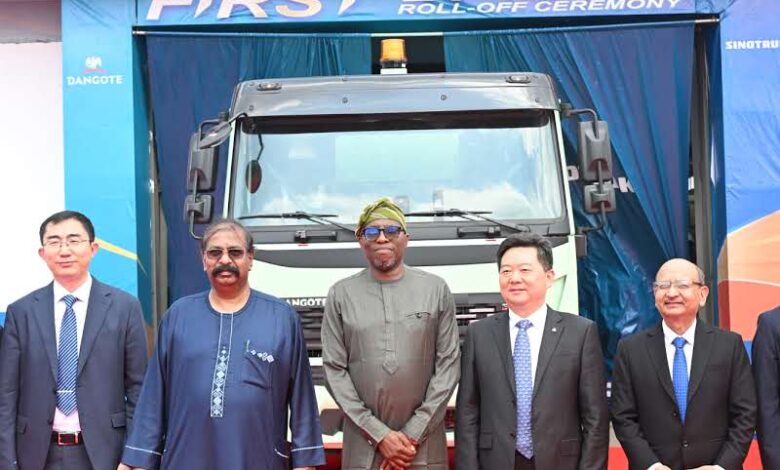
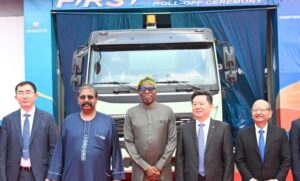
DANGOTE Sinotruk West Africa Limited has rolled out Nigeria’s first locally assembled electric heavy-duty truck, marking a milestone in the country’s automotive industry.
The rollout on Sunday, November 15,also signaled a new era of green mobility, local manufacturing and sustainable transportation across Nigeria and West Africa.
The President and Chief Executive, Dangote Industries Limited, Aliko Dangote, informed at the unveiling that the group plans to increase its investment programme in Africa from $50 billion to about $70 billion under its Vision 2030, with a major intervention in electricity generation to support industrial growth. Dangote spoke when he hosted creative industry stakeholders from Northern Nigeria.
It would be noted that the electric vehicle was unveiled at the company’s assembly facility in Ikeja, Lagos, at an event attended by senior representatives of the Dangote Group, Sinotruk Group, the Lagos State Government, industry stakeholders, customers, business partners and other dignitaries.
The rollout represented a major expansion of the Dangote Sinotruk joint venture from conventional commercial vehicle assembly into new-energy mobility, with the company now offering electric heavy-duty trucks alongside its existing range of heavy-duty trucks, tippers, light trucks, pickups and buses.
Group Vice-President, Dangote Industries Limited, Devakumar Edwin, said the introduction of electric commercial vehicles represented another important milestone in the evolution of the joint venture and demonstrated the Group’s commitment to embracing emerging technologies that can create value for customers while supporting Nigeria’s environmental objectives.
He said the Dangote-Sinotruk partnership was established with the broader objective of building a world-class commercial vehicle business in Nigeria, strengthening local assembly capabilities, transferring technology, creating employment and contributing to the country’s industrial development.
According to him, the partnership followed extensive evaluation of Chinese truck manufacturers before Sinotruk was selected as the preferred technology partner.
“Today, we are taking an important further step as the global economy is looking for sustainable business, that is, vehicles which will also be protective of the environment. So, we went into CNG technology and now we are going into the electric technology. This is a technology which is revolutionising the whole world,” Edwin said.
He noted that the move into electric commercial vehicles reflected Dangote Sinotruk’s determination to remain ahead of technological changes in the global automotive industry and provide customers with more transportation options.
He said: “The electric commercial vehicle offers the potential for lowering the operating cost and reducing the tailpipe emissions. Depending on the application, the electricity cost and the charging infrastructure, it is going to be highly beneficial to the people”.
The rollout comes as Nigeria intensifies efforts to transition towards cleaner energy and transportation solutions, with the Federal Government promoting the adoption of compressed natural gas and other alternative-energy technologies.
Edwin said Dangote Sinotruk was already preparing the infrastructure and technical support required to ensure that electric commercial vehicles could be effectively deployed in Nigeria.
“We recognise that this successful adoption will also require reliable charging facilities, technical expertise and spare parts and a strong after-sales support. So, we are already getting ready with a strong after-sales support. We are setting up our team,” Edwin said.
He added that the company would also support customers with charging infrastructure and technical expertise as it works with government stakeholders, business partners and customers to develop Nigeria’s emerging electric vehicle ecosystem.
He said the electric vehicle rollout was about more than introducing a new product, describing it as a statement of the Group’s commitment to innovation, green energy and the future of mobility.
“This is more than a launch of new vehicles. It’s a statement of our commitment to innovation, our commitment to green energy, and the future of mobility,” Edwin said.
He added that Dangote Sinotruk’s long-term ambition was to develop the business into one of West Africa’s leading automotive assembly and manufacturing companies, leveraging Nigeria’s large market, industrial base and entrepreneurial capacity to serve the wider region.
He said the company would continue to deepen local assembly, facilitate technology transfer, develop Nigerian technical talent, increase local value addition and create more employment opportunities.
As part of the technology-transfer programme, Sinotruk is expected to provide training for Nigerian engineers and technicians, including opportunities for selected personnel to receive practical training at Sinotruk facilities in China.
“This demonstrates our determination to embrace new technologies and provide our customers with more transportation choices,” Edwin said.
President of Sinotruk Group, Liu Wei, described the rollout as a historic moment for Nigeria, the joint venture and the wider African automotive industry, saying the electric heavy-duty truck represented a practical response to Nigeria’s energy-transition ambitions.
He said the truck was the first new-energy truck assembled on the African continent, describing the milestone as a major step towards localised manufacturing and the green transition of commercial transportation in West Africa.
“Today, we gather in the beautiful city of Lagos to witness the official roll-off of the first electric heavy-duty truck from the joint venture. More importantly, it represents a substantial step forward for Nigeria and West Africa in driving localised manufacturing and the green transition of new-energy commercial vehicles,” Liu said.
According to him, the milestone aligns with Nigeria’s long-term carbon-neutrality objectives and energy-transition plans, particularly efforts to modernise the country’s energy mix, decarbonise transportation and strengthen industrial capacity.
He said the partnership between Sinotruk and Dangote Group had evolved significantly since its inception, with the two companies moving from vehicle assembly towards increasingly sophisticated local manufacturing capabilities.
The partnership began in 2010, while the joint venture was formally established in 2014. Its first heavy truck rolled off the assembly line in 2017, while a commercial vehicle welding and e-coating paint line became operational in 2024, marking a further transition towards localised manufacturing.
Liu disclosed that the joint venture had so far assembled more than 8,000 vehicles locally and would continue upgrading its production capabilities to serve Nigeria and the wider West African market.
He said Sinotruk would also deepen training and skills development for Nigerian engineers and technicians, creating opportunities for more young Nigerians to take up technical and manufacturing roles within the evolving automotive ecosystem.
Lagos State Commissioner for Transportation, Oluwaseun Osiyemi described the rollout as a defining moment for Nigeria’s industrial and transportation sectors.
Osiyemi, who was represented by Managing Director, Lagos Bus Services Limited, Engr Olasunkanmi Ojoowuro, said the introduction of locally assembled electric heavy-duty trucks demonstrated that Nigeria could participate actively in the global transition towards cleaner transportation rather than remain dependent on imported automotive technology.
He highlighted the potential benefits of the initiative in reducing emissions, lowering long-term operating costs for transport and logistics operators, creating employment and equipping Nigerian engineers and technicians with advanced electric vehicle and sustainable manufacturing skills.
He also commended Dangote Sinotruk for combining global automotive technology with local industrial capacity and urged continued investment in skills development and local manufacturing.
Dangote said expanding production, creating jobs and providing reliable electricity were essential to unlocking Nigeria’s economic potential. He identified inadequate power supply as a major obstacle to the survival of small and medium-sized enterprises, warning that businesses dependent on petrol and diesel generators would struggle to remain profitable. Dangote said the group was considering a 10,000-megawatt power programme across Africa, potentially including Nigeria, alongside an expansion of the generating capacity dedicated to its own operations.
“We initially planned to invest $50 billion. We are now looking at increasing that to about $70 billion in Africa,” he said.
Explaining the ambition behind Vision 2030, Dangote said African businesses must take greater responsibility for investing in the continent and addressing the infrastructure constraints that discourage other investors. According to him, inconsistent government policies and unreliable electricity remain significant barriers to investment. He said the group had largely addressed the power challenge within its operations by generating its own electricity.
“Across the group, we currently have almost 1,500 megawatts. By the time we complete Vision 2030, that could rise to between 4,500 and 5,000 megawatts,” he said. “That is captive power—electricity for our own operations. Separately, part of the vision is to intervene in power generation with 10,000 megawatts across Africa, potentially including Nigeria.”
Responding to a question about the economic decision that would most improve the lives of ordinary Nigerians, Dangote placed electricity at the centre of the country’s development needs.
He argued that individual households and companies installing alternative power systems would not, by itself, resolve the wider economic problem.
“Installing solar power for yourself does not mean the wider problem has been solved. Other people may not have that option,” he said. “A vibrant economy is driven by small and medium-sized enterprises. Large companies such as ours help sustain those businesses, but SMEs are essential to economic activity. When you generate electricity using diesel or petrol, it becomes very difficult to make money.”
Dangote expressed confidence in Nigeria’s entrepreneurial strength, saying the country had yet to realise the full benefits of its large and dynamic economy. He said businesses had a responsibility to invest and create opportunities, while government should concentrate on providing policies and conditions that allow enterprises to grow.
“Government’s principal responsibility is to create an enabling environment through good policies. With the right policies, businesses can invest and create jobs,” he said.
The industrialist identified agriculture and solid minerals as areas with substantial potential, particularly in Northern Nigeria, but stressed that the country must move beyond exporting unprocessed resources. He said investment in infrastructure, including ports, could open markets for other producers and make it easier for businesses to develop and export their products.
“It is not only about us; it is about Nigeria and the African continent,” he said. “We should not simply export raw materials and then buy back the processed products at many times the price. That is the pattern we want to change. Without production, we will continue to face economic difficulties. We must build a productive economy.”
Sharing lessons from his business career, Dangote attributed the group’s expansion to focus, financial discipline and the consistent reinvestment of earnings. He said the transition from trading to manufacturing was built around products the group already understood, supported by established customers, distribution networks and market knowledge.
“The logical next step was backward integration: producing the things we were already importing,” he said.
Dangote also urged entrepreneurs to avoid spending anticipated profits and to recognise when a venture was no longer commercially viable.
“Give it your best effort, but when you do the numbers and they are not adding up, you must be willing to leave,” he said.
Despite the challenges facing businesses, he maintained that the group would continue investing and encouraged smaller enterprises to build opportunities around major industrial projects.
“People like us will continue investing. People like you can build businesses around those investments—as suppliers, producers and service providers,” he said.