The Pope doesn’t own a private jet:A lesson in institutional responsibility
19
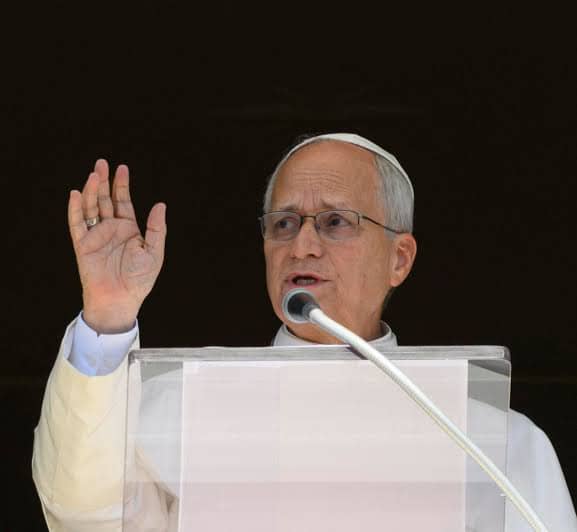
Pope Leo,the Leader of the Roman Catholic church
Fred Chukwuelobe
The Pope is arguably one of the most influential religious figures in the world.
He is the spiritual leader of more than 1.3 billion Catholics worldwide, the head of state of the Holy See and the successor of St. Peter, regarded by Catholics as the Vicar of Christ.
His influence transcends religious boundaries. His movements attract global attention, his pronouncements command international interest, and his visits to countries are often treated as major diplomatic and religious events.
Yet, despite the enormous responsibilities of his office, the Pope does not own a private jet. The Vatican does not maintain a personal presidential-style aircraft for his exclusive use. Neither does the Pope maintain a personal fleet of exotic automobiles to demonstrate his status.
So, how does the Pope travel across continents and keep up with his demanding international engagements?
The arrangement is quite instructive.
The Vatican charters commercial aircraft for papal international journeys. Italy’s national carrier, ITA Airways, which succeeded Alitalia, has traditionally played a prominent role in these arrangements, particularly for outbound journeys from Rome. Depending on the itinerary and diplomatic arrangements, the return journey is often undertaken with the national carrier of the country the Pope has visited.
These are specially arranged flights, with the necessary security, logistical and operational considerations. They are not the Pope’s privately owned aircraft.
There is also an interesting arrangement involving the international media. Journalists, photographers and other members of the press who accompany the Pope on these journeys are generally required to pay for their places on the flights. Major international news organisations consider the expense worthwhile because travelling with the Pope offers exceptional access to his activities, pronouncements and interactions with world leaders.
When the Pope arrives in a country, the host government works with the Vatican to coordinate security, transportation and other logistical requirements. Local transportation, including the provision of suitable vehicles and, where necessary, aircraft for domestic journeys, is arranged as part of the official visit. The financial arrangements vary from country to country.
Think about that for a moment.
A man whose influence reaches virtually every corner of the world, whose movements involve enormous security and logistical considerations, and whose international engagements are watched by billions, does not need to own a private jet to discharge his responsibilities.
Now, let us bring this closer home.
The next time you hear a pastor of a local church boast about owning a private jet, Rolls-Royce Phantom or other exotic vehicles, supposedly because he needs them to keep up with his evangelical travels, perhaps it is worth asking a few questions.
How is it that the Pope, who travels internationally and has a far wider global constituency, manages his engagements without building a personal aviation empire?
The difference is not necessarily in the frequency of travel. It is in the philosophy of institutional stewardship.
The Catholic Church is not the personal property of the Pope. It is a centuries-old institution with established structures, traditions, governance and systems of accountability. The Pope occupies the highest office in the Church, but he does not own the Church, its institutions or their assets as personal property. He is a custodian of an institution that existed long before him and, by its very nature, is expected to outlive him.
This is an important distinction.
The Pope does not build the Church around his biological family or operate it as a personal inheritance project. He is a celibate cleric, as are priests in the Latin Church, and his office is not designed to be transferred to his children or relatives. When a Pope dies or resigns, another succeeds him. The institution continues.
Of course, the Catholic Church is not without its controversies, internal disagreements, historical failures or legitimate criticisms. No institution that has existed for centuries should be beyond scrutiny. But its longevity is also a testament to the importance of institutional continuity, established structures and an identity that transcends the individual who occupies its highest office.
Indeed, the Catholic Church has played an extraordinarily significant role in the development of Western civilisation, particularly through education, healthcare, scholarship, philosophy, the preservation of classical learning and the establishment of universities.
There is a lesson here for religious institutions everywhere, particularly those whose leaders increasingly confuse personal prosperity with institutional success.
A church should be bigger than its founder. Its resources should serve its mission, not become instruments of personal aggrandisement. Its assets should be protected for generations, not treated as the private possessions of whoever happens to occupy the pulpit.
Leadership is not measured by the number of private jets, luxury vehicles or mansions accumulated by a religious leader. It is measured by the strength of the institution he builds, the lives it transforms, the values it upholds and the legacy it leaves behind.
That is why the Catholic Church has survived popes, empires, wars, schisms, persecution and centuries of changing political and social circumstances. Its continuity is not dependent on the personality, wealth or family of any individual Pope.
So, if you are a Catholic, you have every reason to take pride in the institutional heritage of your Church. Not because it is beyond criticism, but because it represents a remarkable example of an institution whose existence is bigger than the individual who leads it.
As Christ declared to Peter in Matthew 16:18:
“You are Peter, and on this rock I will build my Church, and the gates of Hades shall not prevail against it.”
Perhaps religious leaders who pride themselves on their personal acquisitions should pause and reflect on the deeper meaning of those words.
The Church belongs to its mission, not to the man on the pulpit.