Ehime Alex
THE Nigerian oil and gas sector is showing positive signals of global market dominance with the Dangote Petroleum Refinery and Petrochemicals Ltd exporting substantial volumes of petrol, diesel and aviation fuel even as it leads in domestic market supplies.
The refinery exported 84 per cent of its aviation fuel production, 52 per cent of diesel output and 42 per cent of petrol production in October 2026, according to the Nigerian Midstream and Downstream Petroleum Regulatory Authority’s (NMDPRA) October factsheet.

The figures show how the refinery is expanding beyond its role as a major source of domestic fuel supply to become an important supplier to international markets. However, the export volumes also raise questions about how production is balanced between foreign sales, domestic deliveries and the need to maintain adequate fuel reserves.
The refinery operated at an average capacity utilisation of 103.73 per cent in October, based on its installed capacity of 650,000 barrels per day
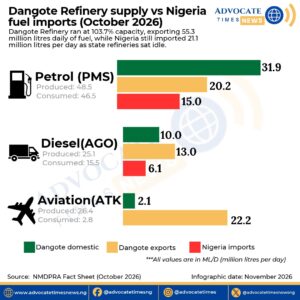
It produced an average of 26.44 million litres of aviation turbine kerosene (ATK) daily, exporting 22.15 million litres, or 84 per cent of output. Only 2.07 million litres went to the domestic market, while 2.22 million litres were added to stock.
The export-oriented allocation helped build aviation fuel reserves, as the refinery’s closing ATK stock rose by 42 per cent to 199.7 million litres, equivalent to about 71 days of national consumption. This contributed to national stock sufficiency of 75.8 days, well above the 30-day regulatory benchmark.
Diesel exports were also substantial, as the refinery produced 25.14 million litres daily and exported 12.95 million litres, representing 52 per cent of output. Domestic supply stood at 10 million litres daily, while 3.20 million litres were in transit at the end of the month.
Unlike aviation fuel, diesel stocks declined, as the national closing stock fell by 14 per cent to 201.1 million litres, with the report also recording an inventory draw of 1.01 million litres in the volume in transit.
Petrol presents a more direct supply trade-off, as the refinery produced 48.51 million litres daily in October, exporting 20.18 million litres, or 42 per cent of output, while delivering 31.89 million litres to the domestic market.
Combined domestic deliveries and exports reached 52.07 million litres daily, exceeding production by 3.56 million litres. The refinery therefore drew down its inventory to meet the combined demand, reducing its closing petrol stock by 37 per cent to 229.9 million litres.
The development is significant because the refinery is supplying virtually all locally refined petrol while also exporting a sizeable share of its output. But the inventory drawdown shows that high production and export volumes do not automatically translate into stronger domestic stock buffers.
The NMDPRA said higher crude receipts at domestic refineries and strong local petrol supply from the Dangote refinery had reduced the country’s reliance on imported petrol.
“Higher crude receipts at domestic refineries and strong local petrol supply from Dangote Refinery mean most of the petrol consumed in October was refined at home, reducing reliance on imports, easing pressure on foreign exchange and improving supply security, it stated.
The Advocate Times can report that this shift could reduce Nigeria’s exposure to imported refined products while allowing domestic refineries to earn foreign exchange from international sales.
The export figures, particularly for aviation fuel and diesel, indicate that the refinery is already serving both markets.
However, the different stock positions across products show that export growth must be considered alongside domestic supply requirements. While aviation fuel stocks were well above the national benchmark, petrol and liquefied petroleum gas (LPG) remained below the required 30-day cover.
National petrol stock sufficiency stood at 21.8 days in October, leaving an 8.2-day shortfall against the regulatory threshold. LPG had the weakest position, with only 14.8 days of stock cover.
The authority warned that the shortfall in petrol and cooking gas reserves remained a concern for supply stability.
“With petrol and LPG stock cover still below the 30-day threshold, steady receipts remain important for supply stability,” it stated.
The figures suggest that Nigeria’s refining transition is producing two outcomes at once: greater domestic availability of locally refined petrol and a growing export business. But the benefits will depend not only on how much refineries produce, but also on whether production, exports and inventory management can support reliable domestic supplies.
The NMDPRA added that it had begun measuring the Dangote refinery’s export performance as a percentage of total production, rather than total evacuation.