Zenith, Ecobank’s non-performing loans show credit risk exposure -Report
32
Harrison EDEH
Nigerian banks reduced or stabilised their non-performing loan (NPL) ratios in the first half of 2026, but rising defaults at Zenith Bank and Ecobank’s still-high ratio show that credit risks remain a concern for the industry.
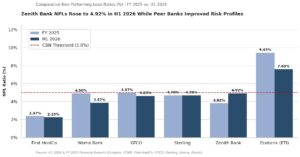
Advocate Times’ analysis of six banks’ interim financial reports shows that First HoldCo, Wema Bank, Guaranty Trust Holding Company (GTCO) and Ecobank Transnational Incorporated (ETI) reduced their NPL ratios between December 2025 and June 2026. Sterling Financial Holdings maintained its ratio, while Zenith Bank recorded an increase.
The NPLs are loans that borrowers have failed to repay as agreed, and when they accumulate, banks may need to set aside more money to cover potential losses, affecting earnings and potentially limiting their capacity to extend fresh credit.
CBN Headquarters building in Abuja
The issue matters beyond banks’ balance sheets because businesses depend on affordable financing to buy raw materials, pay workers, restock goods and expand operations.
The pressure is already evident in the manufacturing sector, as recent data from the Manufacturers Association of Nigeria (MAN) indicates that manufacturers paid an average interest rate of 32.2 per cent on bank loans in 2025, up from 21 per cent in 2020.
Bank credit to manufacturing also fell by ₦1.92 trillion, from ₦8.53 trillion in December 2024 to ₦6.61 trillion in December 2025.
Comparative NPL Performance Table (H1 2026 vs. FY 2025) for the banks reviewed in this analysis
Similarly, in its second-quarter 2026 Credit Conditions Survey, the Central Bank of Nigeria (CBN) recorded that while banks reported improved credit availability and more loan approvals, the lending-rate spread for small businesses widened even as demand for their loans increased.
This suggests that greater access to credit does not necessarily mean cheaper borrowing.
Against this backdrop, Zenith Bank’s rising troubled loans stand out. Its NPL ratio increased from 3.82 per cent to 4.92 per cent, approaching the CBN’s five per cent threshold.
Its Stage 3 loans, classified as credit-impaired, rose 46.5 per cent to ₦618.88 billion from ₦422.41 billion at the end of 2025.
Zenith reported ₦427.93 billion in expected credit loss allowances at the standalone bank level, covering 86.90 per cent of its credit-impaired assets. The allowances are funds set aside to absorb estimated losses if borrowers fail to repay.
First HoldCo recorded the lowest NPL ratio, reducing it from 2.37 per cent to 2.25 per cent. Its Stage 3 loans remained broadly stable at ₦220 billion as gross loans expanded by 6.12 per cent to ₦9.79 trillion.
Wema Bank also improved, reducing its NPL ratio from 4.90 per cent to 3.87 per cent while expanding gross customer loans by 21.27 per cent to ₦2.18 trillion.
GTCO’s ratio fell from 4.97 per cent to 4.63 per cent, while Sterling Financial remained at 4.70 per cent. Ecobank recorded the largest improvement, cutting its ratio from 9.42 per cent to 7.60 per cent, although its consolidated figures reflect operations across 34 sub-Saharan African countries.
While these figures do not establish that rising bad loans caused higher borrowing costs or reduced credit to manufacturers, they highlight why banks must balance lending growth with careful risk management.
Financial analysts believe that, for the wider economy, healthier bank portfolios matter most when they support sustainable lending to productive businesses rather than simply improve financial ratios.