Harrison EDEH
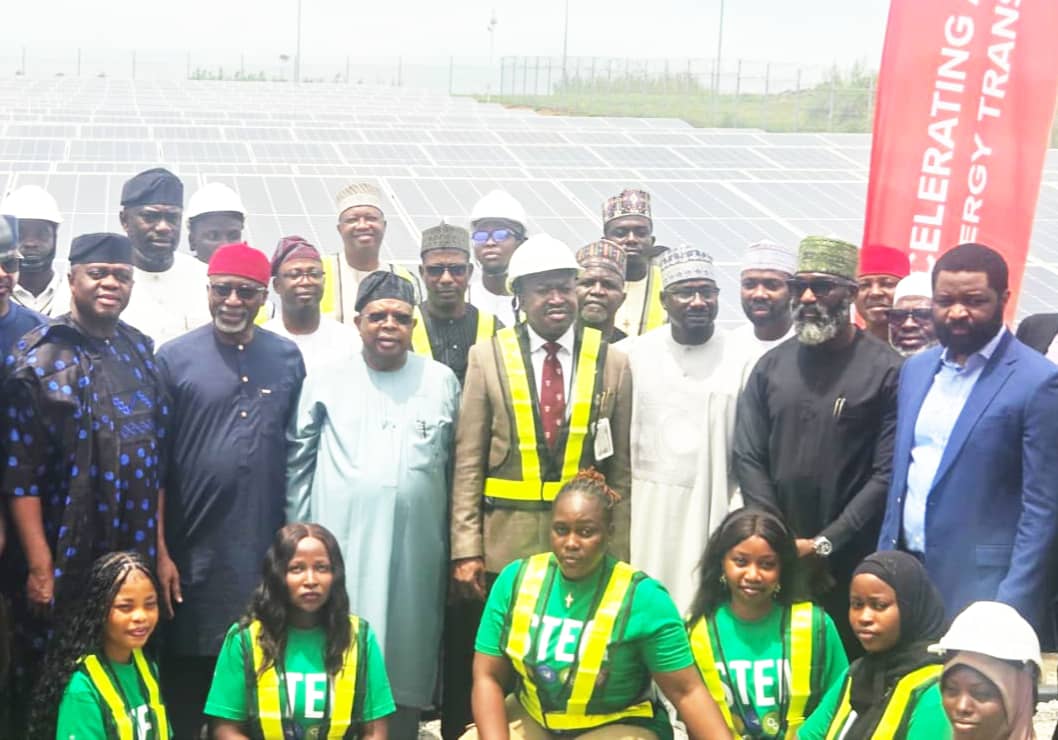
THE Federal Government has commissioned 3MW solar hybrid power project at Yakubu Gowon Univerisity Abuja,as it joined the growing list of federal universities now electrified through clean energy.
The solar facility will provide steady electricity for teaching, research, laboratories, digital services and other critical operations.
It was delivered under Phase II of the Energizing Education Programme [EEP] being implemented by the Rural Electrification Agency [REA] through the World Bank-funded Nigeria Electrification Project, NEP.
With nearly 40,000 students, including over 8,000 living on campus, and more than 3,500 staff, the university has one of the largest energy demands among federal tertiary institutions.
Commissioning the facility, Minister of Power, Joseph Tegbe, said a university is the best place to show what Nigeria’s energy transition can truly deliver.
“There is perhaps no better place to demonstrate the practical value of Nigeria’s energy transition than a university,” the minister said. “It brings together everything a modern energy system must support: learning, research, healthcare, technology, administration and digital infrastructure.”
He added that while the commissioning is a milestone, sustainability will determine its real value.
“The commissioning is not the conclusion of the investment. It is the beginning of its most important phase,” Tegbe said. He linked long-term performance to the newly created Renewable Asset Management Company [RAMCO] which will oversee the management of renewable assets nationwide.
REA Managing Director/CEO, Abba Aliyu, said EEP has evolved from just installing solar panels to transforming how education is powered.
“When the programme was conceived, the ambition was straightforward: to change what reliable electricity could mean for Nigeria’s public universities. Not simply to put solar panels on campuses, but to create the conditions for students to learn, lecturers to teach and laboratories to function,” Aliyu said.
According to REA, over 100MW of clean energy has so far been deployed to 22 federal universities and three affiliated teaching hospitals, impacting more than 600,000 students and 50,000 staff across the country.
Aliyu stressed that focus must now shift from building more to protecting what has been built.
“We have become very good at asking, ‘How do we build more?’ We must now become equally rigorous about asking, ‘How do we protect what we have already built? How do we make it perform?’” he said.
Head of the Nigeria Electrification Project, Olufemi Akinyelure, said the return on powering universities is unmatched.
“When we power a university, we do not merely light buildings; we illuminate minds, enable innovation and strengthen the future of our nation,” he said.
Vice-Chancellor of Yakubu Gowon University, Hakeem Babatunde Fawehinmi-a professor said reliable power is non-negotiable for a modern university.
“A university such as ours cannot teach effectively, conduct meaningful research, operate its laboratories, or sustain digital services without dependable power supply,” he said, pledging that the institution will ensure proper utilisation and maintenance.
Chairman, Senate Committee on Power, *Senator Enyinnaya Abaribe*, said the project shows how policy can translate to real-life benefits, assuring that the legislature will continue to provide oversight and support for sustainable energy investments.
“Sustainability must therefore remain a priority,” Abaribe said.
AdvocateTimes reports that beyond electricity, the project includes a Renewable Energy Workshop and Training Centre for hands-on skills development, plus a female STEM component to give female students practical exposure to the renewable energy sector.
The project was delivered through collaboration between the Federal Government, REA, NEP, the World Bank, Yakubu Gowon University and EMONE Energy Solutions.