Harrison EDEH
THE Nigerian National Petroleum Company Limited (NNPC Ltd.) earned N3.087 trillion in July 2026 and made a profit of N279 billion, but its oil and gas production fell during the month because of operational problems.
The company also paid a total of N7.913 trillion to the Federation between January and July, showing its important role in supporting government revenue.
However, while NNPC’s financial performance remained strong, its oil and gas production dropped from the levels recorded in the previous two months.
Advocate Times reports that the review of the ‘NNPC Limited Monthly Report Summary – July 2026,’ report released recently shows that Nigeria produced an average of 1.68 million barrels of crude oil and condensate per day in July. This was lower than the 1.72 million barrels produced daily in June and 1.73 million barrels in May.
Crude oil production alone fell to 1.44 million barrels per day in July, from 1.47 million barrels per day in May and June. Condensate production stood at 0.24 million barrels per day.
NNPC said the drop was caused by several operational problems, including facility shutdowns, unavailable equipment, pipeline incidents and other production challenges.
Despite the July decline, oil production was still better than the levels recorded late last year and early this year.
Total crude oil and condensate production fell to 1.54 million barrels per day in December 2025 and reached its lowest point of 1.51 million barrels per day in February 2026.
Crude oil production alone had dropped to 1.27 million barrels per day in February before recovering to 1.47 million barrels per day in May and June.
Gas production also followed a similar pattern.
Nigeria produced 7,489 million standard cubic feet of gas per day in July, down from 7,841 million standard cubic feet per day in June.
However, the July figure was still much higher than the 6,284 million standard cubic feet per day recorded in September 2025, which was the lowest level during the 12-month period.
The amount of gas sold also fell in July. NNPC said 4,581 million standard cubic feet of gas were sold per day in July, down from 4,970 million standard cubic feet per day in June. This was also lower than the highest level of 5,059 million standard cubic feet per day recorded in March.
The fall in both oil and gas production shows that Nigeria’s production recovery is still affected by operational problems.
NNPC said it was taking steps to reduce these problems and prevent unexpected shutdowns.
The company said it was carrying out maintenance work, improving the movement of crude oil for export, increasing flexibility in offshore operations and restoring barging operations.
The company also reported that its upstream pipelines were fully available in July.
The report further showed that Nigeria is still struggling to sell a large part of the gas it produces.
Out of the 7,489 million standard cubic feet of gas produced daily in July, only 4,581 million standard cubic feet were sold.
This means that about 61.2 per cent of the gas produced was commercialised.
The figure was lower than the 63.4 per cent recorded in June and below the 68.8 per cent recorded in December 2025.
On average, about 35.8 per cent of the gas produced over the past 12 months was not sold commercially. Some of the gas was pumped back into oil wells to support production, while some was flared or used to run operations.
This means that while Nigeria is producing more gas than before, a large amount is still not being turned into sales and revenue.
NNPC said it was making progress on major gas pipelines expected to improve the movement and supply of gas across the country.
The Obiafu-Obrikom-Oben, known as the OB3 Gas Pipeline, has reached 100 per cent completion, according to the company. All the necessary work on the River Niger Crossing has also been completed.
NNPC said the pipeline was expected to begin delivering gas in August 2026.
The Ajaokuta-Kaduna-Kano Gas Pipeline has reached 95 per cent completion, with work continuing to enable the delivery of gas to Abuja in 2026.
Challenges also remained in NNPC’s fuel retail business.
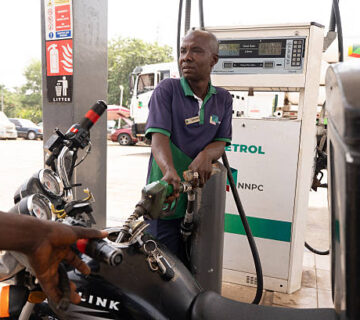
NNPC Retail Limited recorded a nationwide fuel availability rate of 52 per cent in July.
This means that fuel was available at only about half of its retail network during the month.
Overall, NNPC’s July report presents a mixed picture.
The company recorded strong revenue and profit and continued to produce more oil and gas than it did during the low points of late 2025 and early 2026.
However, the fall in production in July and the continued difficulty in selling all the gas produced show that operational problems remain a major challenge.
“All production, sales and financial figures are provisional and subject to reconciliation with relevant stakeholders.
“July crude oil production was affected by a combination of operational disruptions across several assets, including facility outages, equipment unavailability, pipeline incidents, and production constraints,” the NNPC stated.