I grew up in Buguma, in Rivers State, a girl who loved to argue. My grandmother said I was “blessed with a mouth.” My teachers called it “a gift for debate.” I called it survival. In a culture that often taught girls to be seen and not heard, I learned early that if I did not speak, no one would speak for me. That lesson has carried me from the classrooms of Rivers State to England, from the halls of Warwick University to the negotiating tables of Abuja, and, this year, into my fifteenth year in Nigeria’s power sector and my tenth as Chief Executive Officer of the Association of Power Generation Companies (APGC).
Fifteen years is long enough to forget how it started. So let me remember, briefly, before I say anything else.
I did not enter the power sector with a title or a contract. In 2011, I joined as a volunteer at Geometric Power Limited for three months, no pay, just a notebook and a determination to understand how electrons become light. That curiosity carried me next to the Presidential Taskforce on Power, the very room where Nigeria’s reform agenda was being designed. I was, more often than not, the only woman in the room. I stayed anyway.
Two years later, I watched history happen from close enough to touch it: the 2013 privatisation of the Power Holding Company of Nigeria, the boldest gamble in the history of our electricity industry. It was, at the time, more an act of faith than a certainty. Government stepped back. Private capital, private risk, and private accountability stepped in. Everyone celebrated the handover. Almost no one prepared for what came after the debt, the liquidity crisis, the gas shortages, the coordination failures between a fragmented set of new owners who had inherited infrastructure but not yet a shared voice.
That gap, the absence of a unified voice for Generation Companies, became the reason APGC exists, and eventually, the reason I became its Chief Executive Officer.
I will not pretend that ascension was simple. I stepped into the role during what people now call a “glass cliff” moment: a crisis nobody else wanted to inherit, an association still finding its legs, a sector in genuine distress. I was doubted before I had said a single word in most rooms. I have been mistaken for a secretary in meetings I chair. I have watched grown men search the room for “the person actually in charge” while I was standing directly in front of them. I made a decision, early in that career, that I would not allow the smallness of other people’s imaginations to define the size of my ambitions. I would not shrink. I would not qualify my credentials or my presence. I would simply continue to do the work thoroughly, precisely, courageously, and allow the record to speak.
The record, over ten years, speaks of a few things I am proud of.
It speaks of the fight for the sanctity of contract not as an abstract legal principle, but as the difference between a power sector that can attract investment and one that cannot. For years, I made the case, sometimes to audiences who did not want to hear it, that a market where agreements can be casually broken is a market no serious investor will trust twice. I sacrificed goodwill built over many years defending that position. I was confident I was defending my country’s economic future, because if the legal foundation of our reform was weak, everything built on top of it would eventually crack.
It speaks of communication, which I learned the hard way is not public relations. For years the power sector spoke only in acronyms: MW, PPA, VBS, MYTO. Then we wondered why the public was angry at us. I learned that if a fifteen-year-old cannot understand your explanation, you have not yet earned the right to be believed. Tell the truth faster than rumour can travel, because rumour will always try to fill whatever gap you leave behind.
It speaks of resilience in an industry that still, in 2026, asks women to prove themselves twice before it extends the trust it gives men once. I have sat across boardroom tables where the numbers ran into trillions of naira, owed to companies that kept their turbines running on the strength of promises alone. I have never been the loudest voice in the room by volume. But I have, time and again, been the most difficult voice to ignore.
And it speaks, increasingly, of the people who came after me because no legacy that stops with one person is a legacy at all. Ten years in, I have made mentorship less of a hobby and more of a mandate: training programmes for young women entering engineering and energy, capacity-building for the next generation of GenCo professionals, deliberate insistence that the rooms I fought to enter should be easier for the woman coming in behind me. It is not enough to open doors. We must also help women believe the doors are truly open for them.
None of this happened without cost. There were nights I spent negotiating in power plants at two in the morning. There were boardrooms where I was the only person defending a position everyone else in the room found inconvenient. There was a decade of choosing, again and again, to stay in the fight rather than accept the quieter, safer exit that would have cost me nothing but my convictions. I do not say this for sympathy. I say it because I think Nigerians deserve to know that the electricity that reaches their homes and businesses, however imperfectly, is the product of real, tired, stubborn people who decided the sector was worth staying in even when staying was hard.
Where do we go from here?
Nigeria’s power sector still carries the scars of a reform we started but have not finished. The debt overhang between GenCos, DisCos, and government remains unresolved in any durable way. Gas supply constraints continue to strand capacity we have already built and paid for. Regulatory coordination between NERC, the Ministry of Power, and sector operators is better than it was in 2013, but still nowhere near what an industry of this scale and importance requires. These are not complaints. They are the honest state of the sector, and I would rather name them plainly than pretend our work is complete because a decade has passed.
But I am, on balance, more hopeful than I have ever been. I have watched a generation of young Nigerian engineers, lawyers, and analysts enter this sector with a fluency in energy transition, off-grid solutions, and market design that my generation had to learn from scratch. I have watched GenCos that once operated as isolated, competing interests begin to understand the value of a unified industry voice. I have watched international development partners, the World Bank, the African Development Bank, the German development agency GIZ, engage with Nigeria’s power sector not as a charity case but as a serious market worth serious partnership.
Fifteen years ago, I was a volunteer with a notebook, trying to understand how electrons become light. Ten years ago, I inherited a fledgling association during one of the hardest moments in our sector’s history. Today, I lead an organisation that represents the generation backbone of Nigeria’s electricity supply, and I do so as a woman who was never supposed to be in this seat, in an industry that still, some days, forgets to expect me.
I have spent my career applying pressure in the places that mattered legal, regulatory, reputational and I intend to continue. Not because the work is finished, but because I have never believed that power, in any sense of that word, was something to be granted. It is something you build, argument by argument, contract by contract, room by room, until the people who once doubted you have no choice but to reckon with the record.
That has been my last fifteen years. I suspect it will be my next fifteen, too.
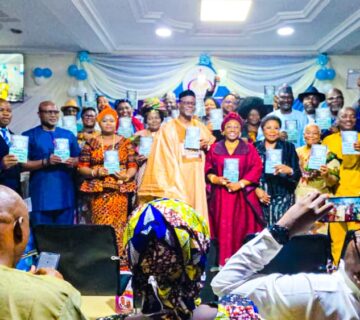
This year, I am marking both milestones, fifteen years in the sector and ten years at APGC, with a gathering I have chosen to call “15 Years of Power, 10 Years of Purpose.” It will bring together regulators, GenCos, DisCos, development partners, and many of the people who have shaped this journey alongside me, and it will include the launch of a memoir documenting the years I have described here in far more detail than a newspaper column allows. If this piece has told you the summary, the book tells you the argument behind every line of it.
By Dr. Joy Ofinjite Ogaji, the Chief Executive Officer of the Association of Power Generation Companies of Nigeria (APGC)