****FG accounts for N152.77 trillion, or about 91.6 per cent, of the total debt
Harrison EDEH
Nigeria’s public debt has climbed to N166.79 trillion, even as the Federal Government continues to seek fresh external financing to fund climate resilience, social protection and other development programmes.
This development has put renewed focus on the country’s ability to generate enough revenue to meet its growing obligations,despite the removal of petroleum subsidy which was expected to rake in more revenue for the government.
According to the latest Debt Management Office (DMO) figures, public debt increased by N7.44 trillion, or 4.7 per cent, between March and June 2026, from N159.35 trillion to N166.79 trillion.
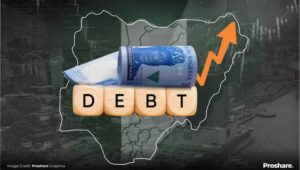
The increase came as domestic debt remained the larger component of the portfolio at N91.59 trillion, while external debt stood at N75.20 trillion, with the Federal Government accounting for N152.77 trillion, or about 91.6 per cent, of the total debt.
The pressure grows when viewed against the government’s ongoing need for new borrowing, as the Federal Government is currently seeking three new $500 million World Bank facilities, totalling $1.5 billion, to finance climate resilience, social protection and early childhood development programmes.
One proposed facility is an additional $500 million for the Agro-Climatic Resilience in Semi-Arid Landscapes project, known as ACReSAL.

The financing would increase the programme’s total funding from $700 million to $1.2 billion.
According to the World Bank, the additional financing would support landscape restoration, flood and erosion management, irrigation, water storage, reforestation and other measures aimed at improving climate resilience.
It also proposed a $500 million Household Prosperity and Empowerment-Social Protection project designed to expand cash transfers, strengthen Nigeria’s social registry and improve delivery of social assistance to poor and vulnerable households, while the third $500 million facility is aimed at early childhood development.
These loans are development-focused and largely concessional, meaning they are offered on more favourable terms than borrowing from commercial markets. However, they still add to Nigeria’s external obligations and ultimately have to be repaid.
The critical fiscal question this has created is how quickly government revenue is growing relative to the debt being accumulated and the cost of servicing it.
The Advocate Times review shows that Nigeria’s debt stock has increased by N79.41 trillion, or 90.9 per cent, from N87.38 trillion in June 2023 to N166.79 trillion three years later.
While the increase does not mean that the entire N79.41 trillion represents new borrowing, because exchange-rate movements can increase the naira value of foreign-currency debt, the structure of the debt has also changed.
Domestic debt accounted for 60.74 per cent of total public debt at the end of 2023 but had fallen to 54.91 per cent by June 2026, as external obligations increased their share.
Within domestic borrowing, FGN bonds accounted for N64.84 trillion, including N22.11 trillion in securitised Ways and Means advances. Treasury Bills accounted for another N19.48 trillion.
The fiscal pressure is therefore not simply about the size of the debt stock, but about how much the government must commit to debt service while still financing infrastructure, social programmes and economic development.
Former Vice-President Atiku Abubakar had questioned the government’s borrowing strategy, arguing that rising obligations could restrict resources available for public services.
“A government that says more money is coming in must explain why it keeps borrowing and why the people paying for its policies cannot see the promised gains,” Atiku said.
He urged the government to “identify the old debt newly recorded, the foreign debt whose naira value rose with the exchange rate, and every new loan contracted since he assumed office.”