
Harrison EDEH
THE Dangote Refinery’s planned ₦2.15 trillion public offer is less about raising cash for the refinery’s existing operations than financing its next transformation, with every naira of the net IPO proceeds earmarked for expansion, the Advocate Times review shows.
According to the Dangote Petroleum Refinery and Petrochemicals Free Zone Enterprise (DPRP) prospectus, the refinery plans to more than double its recently increased processing capacity from 700,000 barrels per day to 1.4 million barrels per day by 2029.
That makes the IPO fundamentally a growth-financing exercise. The offer is not designed to fund dividends, repay existing debt or provide working capital.
After estimated offer expenses of ₦41.49 billion, DPRP expects to retain ₦2.111 trillion, all of which will go into capital expenditure for the expansion programme.
Capital expenditure refers to money spent on long-term assets such as processing units, equipment, utilities and infrastructure.
The prospectus says, “After deduction of the costs and expenses of the Offer, estimated at ₦41,492,782,688.91 (representing 1.93% of the gross Offer proceeds), the net Offer proceeds of ₦2,111,007,217,311.09 will be applied towards growth capital expenditure in connection with the Issuer’s refinery expansion programme.”
The significance is that investors buying into the IPO are effectively being asked to finance the next phase of the refinery rather than simply buying into the earnings generated by the existing plant.
DPRP estimates the five-year expansion programme will cost about $14.3 billion. The IPO therefore covers only part of the required investment, leaving the refinery to fund the balance through internally generated cash, debt and trade or project financing.
Of the ₦2.111 trillion net IPO proceeds, ₦841 billion, or 39.8 per cent, is allocated to utilities, offsites and related infrastructure.
Another ₦686.5 billion, representing 32.5 per cent, is earmarked for refinery processing units and major equipment, while ₦583.5 billion, or 27.6 per cent, will fund construction, installation and other expansion work.
This allocation provides a clearer picture of what the public offer is intended to build. The largest portion is not going directly into another crude-processing unit but into the wider infrastructure needed to support a much larger refinery.
The expansion involves the addition of a second crude distillation unit, or CDU. A CDU is the main processing unit that separates crude oil into different products.
DPRP also plans to expand polypropylene production from 830,000 tonnes per year to 2.4 million tonnes per year by 2030 through a new propane dehydrogenation unit.
The refinery is therefore moving beyond the question of whether it can operate at scale. The new question is whether it can successfully execute a much larger industrial system.
The prospectus itself warns that large-scale expansion projects face risks including cost overruns, construction delays, supply-chain constraints, labour shortages, regulatory delays and unforeseen technical problems.
“Large-scale industrial expansion projects of this nature are subject to significant execution risks, including cost overruns, construction delays, engineering design modifications, supply chain constraints, labour shortages, regulatory permitting delays and unforeseen technical challenges,” DPRP said in the prospectus.
There is also an important ownership dimension to the IPO.
DPRP has 120.13 billion shares issued before the offer, while the base IPO involves only 4.1 billion new shares. After the offer, new public shareholders will hold about 3.3 per cent of the enlarged share capital.
Even if the full 30 per cent oversubscription option is exercised, the public float would rise only to about 4.25 per cent.
This means the IPO creates public ownership without materially changing control.
Dangote Oil Refining Company Limited would still hold about 63.7 per cent after the base offer, while Dangote Industries Limited would retain 14.4 per cent and NNPC Limited about 6.6 per cent.
For the market, this creates an unusual proposition: investors are being offered access to one of Nigeria’s largest industrial assets, but the amount of the company placed in public hands remains relatively small.
The more important test, however, is whether the ₦2.111 trillion raised from the public can help unlock the much larger $14.3 billion expansion.
DPRP has already moved from commissioning losses to strong profitability. It generated ₦19.13 trillion in revenue and ₦2.50 trillion in profit after tax in the first half of 2026, after recording a ₦723.06 billion loss in 2025.
That turnaround gives the company a stronger internal source of funding. But it also raises the stakes for execution.
The IPO is therefore not simply a listing of an already completed refinery. It is the market’s entry into a refinery that is still being built into something significantly larger.
In that sense, the real story of the IPO is not the ₦2.15 trillion offer itself. It is the attempt to use a small public-equity raise as one part of a much larger financing structure to turn a 700,000-barrel-per-day refinery into a 1.4 million-barrel-per-day industrial complex.
Dangote refinery and World’s largest refinery dream in 2028
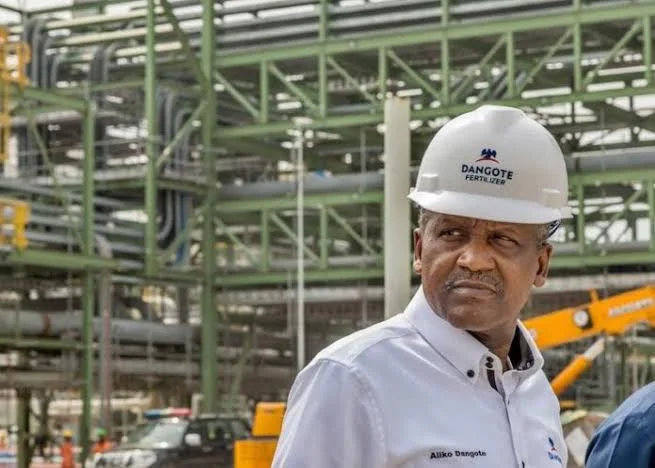
Advocte Times reports that Aliko Dangote, President of Dangote Group, says the Dangote Petroleum Refinery and Petrochemicals will become the world’s largest refinery by 2028.
Dangote made the statement on Monday during the preliminary signing ceremony for the proposed initial public offering (IPO) of the refinery.
“Today marks a significant milestone for us as not just a company, but as Nigerians and also Africans,” Dangote said.
He said the 700,000-barrel-per-day refinery was already Africa’s largest and the world’s largest single-train refinery, adding that it would become the biggest in the world by 2028.
Dangote also spoke about the challenges involved in developing the project, saying the journey started more than 10 years ago with support from banks.
He said the banks backed the project even before they had seen the refinery site or a licence for the facility.
“Today also shows that nothing is impossible for us to achieve once we are focused and determined,” Dangote said.
“Our vision 2030 mantra at the Dangote Group is accelerating Africa’s industrialisation. We have learned the hard way, and we cannot industrialise if we do not have energy security.”
He said the group had therefore increased its focus on energy security in Nigeria while also expanding its industrial projects across Africa.
Dangote said the group had announced investments in countries including Ethiopia, Kenya, Tanzania and Namibia.
On the proposed IPO, Dangote said the shares would be available to everyone and not limited to a particular group of investors.
“There is no segregation on who can own the shares,” he said.
“We want every human being living on the continent to be part of this action, and I’m sure they will continue to be happy now, in future, and forever.”
David Bird, CEO of Dangote Refinery, said the facility supplies Nigeria while also focusing on markets across West Africa.
He said the refinery’s products had reached international markets and highlighted its role as a major supplier of jet fuel to Europe.
“There is no better time than right now to demonstrate the world class quality of our products because we are the largest jet fuel supplier into Europe,” Bird said.
Bird said the refinery had performed strongly in the past six months and helped reduce some of the impact of supply disruptions caused by conflicts in the Middle East and Ukraine.
He added that the refinery could process different types of crude oil and supply several international markets.
According to Bird, the 700,000-barrel-per-day facility is Africa’s largest refinery and already ranks among the five or six largest refineries in the world.
He said the planned expansion had already been fully sponsored, engineered and procured, leaving construction as the main work still to be completed.

