By Fred Chukwuelobe
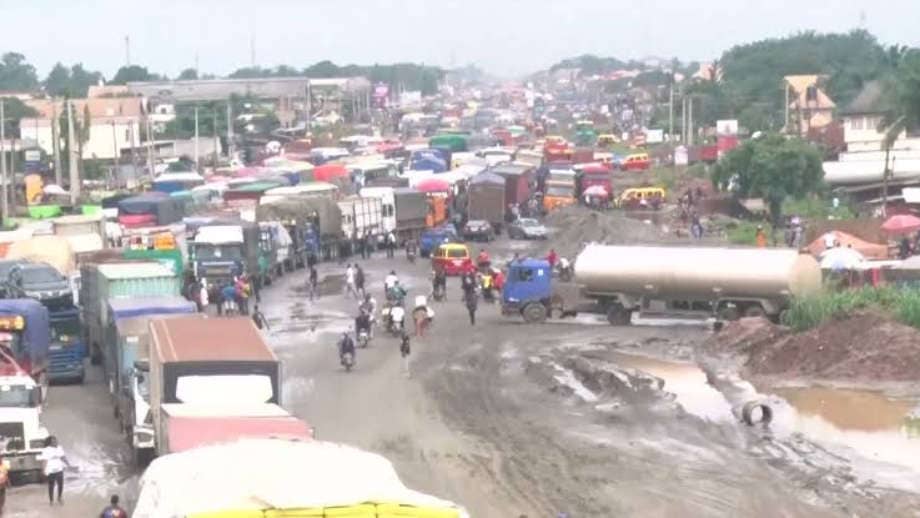
IT grieves my heart to watch travellers – women, children, the elderly and thousands of other Nigerians – stuck for hours and, in some cases, days on the Lagos-Benin-Onitsha expressway, especially the stretch between Benin and Onitsha.
A friend of mine who spent two days on that road recently wept while telling me his ordeal. He was so traumatised that he swore there was no government in this country or, if there was one, it must be a wicked and soulless government that had become completely insensitive to the suffering of its people.
Another friend left Lagos on Sunday. Three days later, he was yet to get to Onitsha.
Three days!
What kind of country allows this to happen to its citizens?
This is not a war zone. These are not refugees running from an insurgency or natural disaster. They are ordinary Nigerians travelling on one of the most important roads in the country.
I recall writing recently about the terrible traffic situation and the pains people were going through on this road. I warned about the consequences, especially with the rains. Somebody I thought was a responsible and knowledgeable person dismissed my article as “bunkum.”
The person was Kassim Afegbua, former Commissioner for Information in Edo State and former media adviser to Ibrahim Badamasi Babangida.
This was what he wrote in response to my article:
“If you have brain, you ought to know that roads are not constructed during rainy season. All identified roads have been awarded and works are ongoing, but now slowed down because of the currency of rainfall. And you sit here and write balderdash. Bunkum.”
I remember those words today.
Not because I want to engage Afegbua in a needless argument, but because the situation on that road has shown just how serious the problem was and how dangerous it is to dismiss legitimate concerns about the condition of our infrastructure.
Thank God President Bola Tinubu thought otherwise. He has now directed the Minister of Works, Dave Umahi, to take action to ease the gridlock.
I would have been much happier if the President had given that marching order one year ago.
The Lagos-Ore-Benin-Onitsha road is not an ordinary road. It is one of the busiest and most important highways in Nigeria. It connects the South-West to the South-South and South-East and carries thousands of people, trucks and goods every day.
Why, therefore, have successive governments failed to treat it with the urgency it deserves?
I cannot fathom why past governments, and even this present government until now, did not declare an emergency on this road and move decisively to reconstruct the bad portions or, at the very least, carry out comprehensive palliative work before the rainy season.
Nobody should have been surprised by what is happening today.
We know when the rains come. We know what happens to bad roads during the rainy season. We know the volume of traffic on the Lagos-Benin-Onitsha corridor. We know the consequences of allowing a road of this importance to deteriorate.
Yet we waited.
Now the rains have come, and innocent Nigerians are paying the price.
What is happening on the Benin bypass and adjoining roads is particularly distressing. People are spending nights in their vehicles. Food and other essential supplies are running out. Perishable goods are being destroyed. Commercial activities have been badly affected. Women, children and elderly people are being subjected to unnecessary hardship.
And for what?
Because a major national highway was allowed to get to this point without the kind of urgent intervention it deserved.
This is one reason I get angry when people attack those who raise their voices about problems in this country.
Why do we always wait until things become unbearable before we act?
Why must somebody first die, become stranded for days or suffer unimaginable hardship before government responds?
When somebody writes about a problem before it becomes a catastrophe, the sensible thing is to examine the issue – not abuse the writer like Kassim Afegbua did.
I have heard young Nigerians repeatedly demand that the older generation should hand over power to them. But looking at what is happening in Nigeria today, I have become convinced that age is not the problem.
Some young people are no better than the old people they criticise.
Indeed, some of the worst manifestations of arrogance, intolerance and indifference can be found among people who are still young.
I have also come to realise, rather painfully, that education does not necessarily make somebody a good leader.
Leadership requires empathy.
It requires competence.
It requires a genuine concern for the people.
There seems to be a demon of indifference that has possessed many of us, particularly those who occupy positions of authority. They appear to have become so removed from ordinary Nigerians that they no longer understand what it means for a family to spend two or three days trapped on a highway.
The person sitting in an air-conditioned office may see a traffic report and move on. But the woman with a child in a vehicle that has not moved for 10 hours experiences it differently.
The elderly man travelling for a medical appointment experiences it differently.
The trader whose goods are spoiling experiences it differently.
The driver who has been awake for 24 hours experiences it differently.
These are human beings, not statistics.
That is why what is happening on the Benin-Onitsha axis should concern every Nigerian.
It is a national shame.
I welcome President Tinubu’s intervention and hope Minister Dave Umahi will move quickly. Nigerians do not need another promise or another explanation. They need the road fixed. They need to travel without spending days on a journey that should take a fraction of that time.
And perhaps those who were quick to dismiss concerns about the road as “bunkum” should take another look at what is happening there today.
The people trapped on that road do not care about anybody’s argument. They simply want to get home.
Those who brought us to this sorry state, through negligence, indifference or failure to act when action was required, must someday answer to the people.
And if there is indeed a hell, as many of us believe, then those who abuse public trust and knowingly allow millions of people to suffer needlessly should reserve a place for themselves in its hottest corner.

Fred Chukwuelobe,fnipr, journalist and public affairs commentator writes from Lagos